Showing posts with label forecasts. Show all posts

Monday, September 30, 2013

Half of ad gains from mobile

The latest quarterly forecast of the U.S. advertising economy from ZenithOptimedia Group predicts that spending on advertising in the U.S. will show a 3.4% growth for 2013.  That's a slight downturn in the previous prediction of 3.5% growth.  The future looks a bit better - predictions of 4.5-4.5% growth in 2014-2015.  However, this remains significantly lower (20%) than what is predicted for global ad growth over the same period.  And on a global perspective, growth in advertising expenditures will continue to trail growth in GDP.

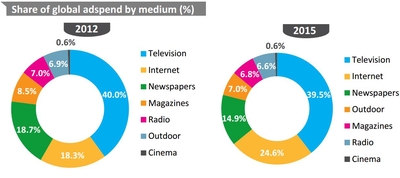
The problem for traditional media is that almost all of the growth is driven by digital advertising formats.  ZenithOptimedia forecasts that digital advertising will account for 21.8% of all US ad expenditures this year, and continue to grow to 28% of ad revenues in 2015.  And the fastest growing segment in digital is mobile.  (The figure shows global ad spending)
“Mobile advertising is still relatively small,” the Publicis media shop notes in its report, adding: “we expect it to total $6.2 billion this year, or 3.7% of total ad expenditure – but it is growing extremely rapidly.”
Another way of putting things is that the 2013 growth in mobile advertising accounts for about half of the total gains in US ad spending, and more than a third of global ad gains.  Total digital ad growth will account for two-thirds of total global growth in

In contrast, the study predicts that TV global ad share will peak in 2013 at about 40%, while newspaper's share will continue to fall, reaching 15% by 2015.  The shares for magazines, radio, and outdoor will also continue to decline.

Sources -  Upward Mobility: Hand-Held Web Accounts For Half of U.S. Ad Expansion, MediaPost Agency Daily
Executive summary: Advertising Expenditure Forecasts, September 2013,  ZenithOptima press release

Saturday, August 24, 2013

Digital Accounts for Quarter of all Media Ad Revenues

eMarketer reports that digital advertising revenues will hit $42.26 billion by the end of 2013.  That's almost a quarter (24.7%) of projected total media advertising.  That will amount to a 15% growth in digital advertising from last year.

The numbers are slightly ahead of eMarketer's projections from last year.  The upward revision is due largely to the unexpected growth rate of mobile advertising spending.

The new numbers suggest mobile advertising will generate $8.51 billion in 2013, almost double of last year's $4.36 billion.  This year, mobile will account for about a fifth of digital advertising dollars, and 5% of all media advertising revenues.
Mobile's share of total media advertising is forecast to triple (to 15.8%) by 2017.


Monday, April 29, 2013

Downgrading 2013 Ad Outlook

Two of the top industry analysts have had to issue revised forecasts for 2013 as revenues, based on the year's slow start.  Publicis' ZenithOptimedia dropped its forecast for global ad revenue growth to 3.9% (down 5%), and US ad growth to 3.4% (down 3%).  Pivotal Research Group wasn't as optimistic, lowering its US ad growth rate to 1.2% this year.

The Zenith Optimedia report projected that global online ad revenues will continue its hot pace, growing 14% annually through 2015.
“Some broadcasters are starting to trade packages that include both online video and television spots,” (Publicis' Jonathan Barnard said), adding: “Advertisers are now recognizing the value of social media for brand building and purchase consideration purposes.”
Pivotal Research Group also forecast that digital will continue to grow faster than analog. Analyst Brian Wieser noted that growth is being driven by new brands seeking to differentiate themselves from competitors:
"(Those) advertisers can and will allocate significant shares of their budgets to digital advertising, as this has become the dominant ‘engagement’ medium for most advertisers, effectively replacing the role that print-based advertising served for so many years.”
Still, TV advertising dominates, although experiencing some shifts among subsectors -
“Cable will probably gain share of national TV budgets at a slightly faster pace in 2013 than occurred last year,” (Wieser) writes, adding: “On this basis, we forecast cable advertising growing by 5%, with broadcast networks down by 2% for all of 2013.”

Source -   Forecasters Downgrade 2013 Ad Outlook: Remain Bullish On Future, Especially For Digital, TV,  MediaDailyNews

Monday, March 25, 2013

Ad spending shifting Online

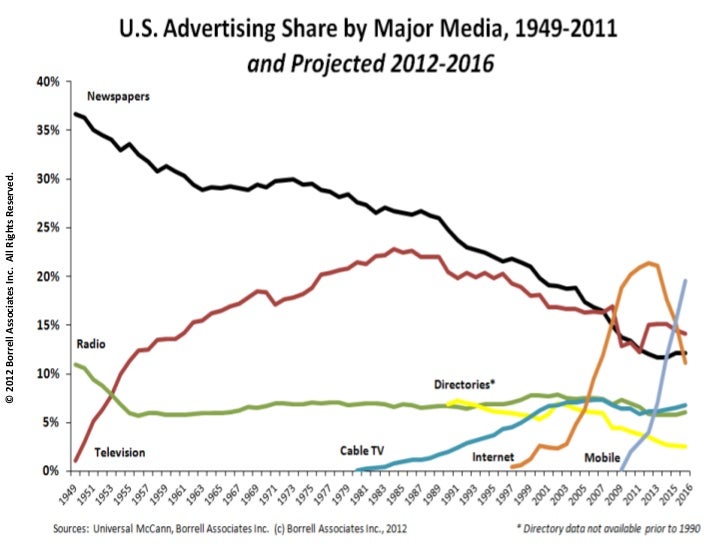
2013 is looking to be a major transitional year - one where a lot of big changes are occurring in the media landscape.  Here's an interesting table from Borrell Associates on the change from 2012 ad levels and those forecast for 2013 (in the U.S.).
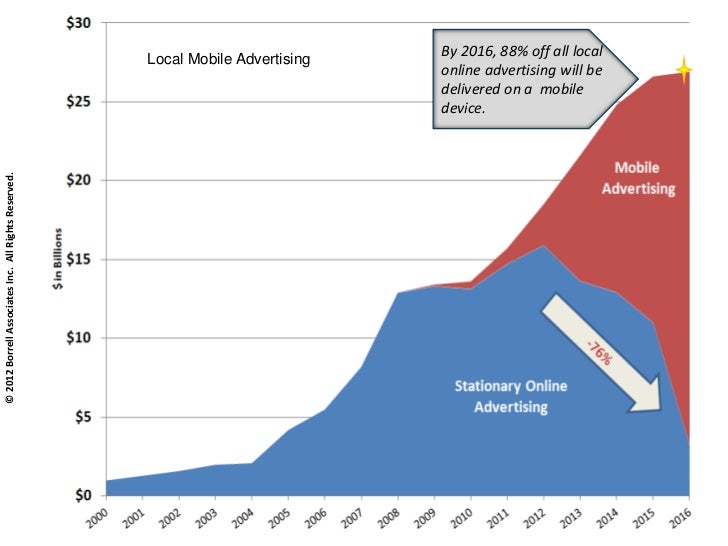
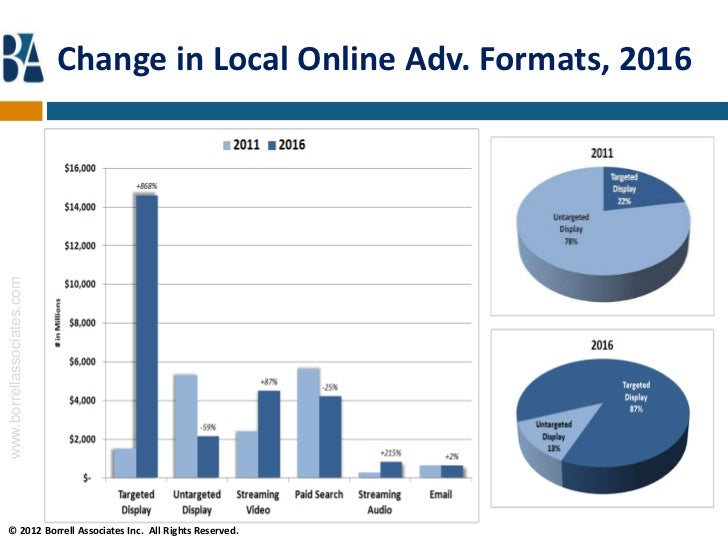
The biggest change is the boom in online advertising - up 17% in the national ad market, and up 30% in the local ad market.  One factor aiding that growth is the success of Google Adwords service, which has grabbed 44% of the global online advertising market.
The table above looks at the share of advertising dollars for various media in the U.S.  The most notable trend is ref;ected in the black line of newspapers, who have seen their domination of advertising revenues fall precipitously, eventually surpassed by the television market.  If you combine TV and cable, they indicate that video advertising now dominates - while radio's share has been fairly stable over time.  The table shows the rapid increase in internet advertising - the downturn in their golden line is for forecast revenues, after pulling out the new media darling for advertisers - mobile. 

If you combine internet, mobile and social advertising, you see that online advertising is set to compete for top share, if not become the dominant media for advertising.  The opportunities that mobile and social media offer for targeting is just starting to be explored by advertisers.  The next few years should see a lot more investment in highly targeted, highly contextual, mobile and social advertising.
 

Source -  Local Advertising & Online Forecasts for U.S. to 2016,  Borrell Associates presentation

Friday, March 1, 2013

Milepost: Global Music Sales Actually Rise

On the heels of the news of iTunes' sales of songs surpassing 25 billion (6 Feb, 2013), comes a report that total global music sales actually increased in 2012 - the first increase since 1999.

  Global music industry trade group IFPI released their annual report earlier this week, showing a very modest increase in total sales revenues of 0.3%, to US$16.5 billion.  While the increase isn't huge, it is the first year-to-year gain seen in the 21st century.  In addition, while the industry has long blamed their decline on digital music, the latest report from the IFPI touts the growing contribution of digital music sector as the driving force behind the (hoped-for) recovery of the music industry.
“Digital is saving music,” said Edgar Berger, Sony Music’s international chief.
  The report puts annual growth of the digital music sector at 9 %, and being driven by a variety of revenue streams - sales of downloads, licensing to both subscription-based and advertising-based online streaming services, music video downloads and streaming.  In addition, there's been a huge increase in the expansion of digital music markets around the world.  While only 23 nations had viable (and legal) digital music marketplaces at the start of 2011, the end of 2012 saw more than a 100 nations where major digital music outlets operated.  Some quick supporting stats -
  • Digital sources now account for more than a third of all global music sales.  Downloads currently account for 70% of the total.
  • Licensed music streaming services saw a 44% increase in the number of subscribers.  The success of subscription music streaming services has opened up licensing fees as a major new revenue source for music labels.
  • Social media is becoming an important channel for music promotion and fan engagement, as well as digital sales.
  • Digital sources account for more than half of all revenues in a number of markets, including the U.S., India, Norway, and Sweden.
  • Acceptance and use of digital music sources is expanding globally.  More than 100 countries have legal markets for digital music, and surveys suggest more than 60% of all Internet users have used a music subscription service in the previous six months - a number than jumps to 80% among young adults (16-24 age group).
  • iTunes song sales generate about a quarter of all global music industry sales ($4.3 billion in sales generating $3.4 billion in licensing to music labels for 2012).
  The IFPI argues that this year's results, and the continuing expansion of digital music into markets around the globe, signal the return of the industry.  The report goes so far as to argue that digital music will be a major driver of the digital economy.

  It may be a bit early for for a victory lap.  The global total sales are still well below the industry's sales peak of $29 billion, as well as being well below revenues for other forms of media and digital gaming.  Still, it is a positive sign for an industry that's been having hard times.  I'm also glad to see the belated embrace of digital music and the range of new revenue streams it's been creating.

Sources -   History Shadows an Upbeat Music Sales Forecast, New York Times
IFPI publishes Digital Music Report 2013,  IFPI press release
Wednesday Apple Rumors: iTunes Music Revenue Up 10% in 2012,  Investorplace.com
IFPI Digital Music Report 2013, study report
The Digital Music Consumer - A Global Perspective, February 2013, slides for research report from Ipsos MediaCT


Wednesday, November 14, 2012

What future for cable MSOs?

Today I want to look at the future of cable, considering that cable MSOs are facing a lot of the same changes and issues as the TV networks. 
  The future of cable depends on your definition.  A while ago, I coauthored a chapter on the economics of cable that found that the cable industry in the U.S. had gone through three distinct phases - cable as CATV (Community Antenna TV), cable as TV of Abundance (massively multichannel TV), and transitioning to cable as broadband over the last couple of days.  The future for cable as CATV ended officially with the 1984 Cable Act, although cable as multichannel TV had been transforming the industry since the late 1970s.  Similarly, you could argue that the future for cable as multichannel was dismal after the 1996 Telecomm Act, as the Act opened the way for multichannel competition.  (Actually, DBS started a few years earlier, but the Act removed cable's local monopoly status).  Luckily for cable, there was broadband, and Internet access has been the profitable service for cable systems for the last decade.
  Now, even the cable industry is recognizing that it is broadband digital services, not multichannel TV delivery, that is the future of the industry.
"Clearly the relative importance of the video business has declined over time. I think broadband clearly is becoming the anchor service."  Glenn Brit, CEO Time Warner Cable
You can also see it in Comcast's move with Xfinity, which is essentially a broadband service featuring lots of TV channels - a service that is more like Verizon's FiOS and AT&T's U-verse services than old-style cable over coax.
  Still, that would leave cable MSOs with expensive hybrid systems on the ground, competing with fiber-based telco broadband services on the broadband front, and with those services, DBS satellite services, and IPTV (video streaming over the Internet) for access to TV programs.  The real problem for cable as broadband, though, are two emerging services - LTE and 4G wireless broadband and Google's Giganet overbuild.  Both have the potential to provide faster broadband data service than existing services.
  Most cable as broadband providers set aside around 30 Mbs of bandwidth for data/Internet services, which is split among all online users linked to the neighborhood hub.  They've been pushing the hubs further downline, so fewer customers are sharing, but would need some significant upgrading to offer higher speeds.  Some of the big MSOs have upgraded some systems to 30-50 Mbs (Charter-30Mbs, Time Warner-35Mbs, Cablevision-50Mbs), but still split that bandwidth among active users.  And if you want to get the highest speeds you pay significantly more.
  In contrast, the telco-based services tend to use DSL-based approach, which provides each user with dedicated bandwidth.  The advertised speeds of these tend to be lower than what cable offers, but remember that cable splits that bandwidth among a number of users.  Thus, the actual speeds that telco-based services provide often can end up being faster, and the service more reliable.  Depending on what kind of DSL service is offered, between 10-30 Mbs of dedicated bandwidth is available.  Telco-based systems also charge more for higher bandwidth availability/speeds.
  The latest report from the FCC shows that the current network/ISPs are doing a good job at actually reaching advertised speeds.  Also that users are moving to higher bandwidth offerings, past the point where you have the speed to stream HD video programming in real time (that's about 10 Mbs to be safe).
  While those speeds seem high, 4G and Google's fiber networks promise significantly more. There's currently a wide variety of 4G mobile broadband systems under development. As they're emerging, here's what the technical standards call for in terms of broadband bandwidth: HSPA+ provides 20-672 Mbs download speeds; Mobile WiMax can provide 37-365 Mbs; LTE provides 100-300 Mbs (LTE-Advanced can handle up to 1 Gbs (1000 Mbs)); and even weak sister MBWA provides for 80 Mbs.  All of these are similar to cable's offerings in that these numbers reflect total bandwidth available to be shared among users.
  If you've got LTE service available, you've got twice the bandwidth/speed of the best that cable and telco-TV land-based services currently offer - at least until the local node gets clogged with users.  And most of the upgrades to 4G are building to the high end of data bandwidth standards, so 4G mobile broadband users will see access speeds 2-30 times faster than current land-based network offerings.  And then there's Google's Giganet fiber network.  Google's pilot fiber network in Kansas City promises dedicated Gigabit access speeds (1000Mbs), a Terabyte of Cloud storage, and provides a free Google Nexus 7 tablet as a remote control (in addition to a rapidly expanding range of TV networks).  That's 20 times the bandwidth / speed currently available from traditional cable and telco based ISPs, for about the same price. It's also 2-10 times the capacity that 4G mobile broadband offers.
  What 4G and Giganet services provide are the speeds that allow multiple users of the ISP account to watch separate HD-quality video streams. If 4G services can offer viable flat rate pricing, this is likely to speed up the move to Internet video streaming as a significant source of TV viewing.  Amazon's already offering flat rate pricing for LTE service on its top Kindle Fire HD model ($50/yr for 250 Mb per month) - which will encourage others to follow.
   TV watching is already shifting to Internet video delivery (as shown by most media use research, and the booming Netflix, Hulu+, and Amazon Prime subscriber base), but bandwidth and pricing become limiting concerns.  If viewers can get bandwidth capable of handling one or more HD video streams, at a price that doesn't make them pause and wonder if the program they want to watch is worth the added data fees, the transition to online delivery will speed up.  Critical to that perspective is flat rate pricing, like what cable offers - access to the programming you want for a flat monthly fee.  Viewers are less likely to shift to online delivery if they have to wait too long to start watching, or if they're worried about exceeding caps and/or the added cost of the program.

In sum, cable MSOs face increased competition, and may soon be relegated to the less valuable and attractive alternative for broadband services - the aspect they're embracing as the future of cable MSOs. A combination of technology and pricing strategies are at play. Within the next year or so, cable broadband speeds will be surpassed by mobile 4G and pure fiber networks.  Without yet another significant and costly rebuild of their systems, they're increasingly likely keep losing subscribers to alternative broadband services.  In addition, the trend among cable MSOs has been to shift from flat rate pricing (without caps) to pricing with caps and usage-based pricing.  That's not what users prefer, especially those considering shifting their viewing to online sources.
  Another key concern driving cord-cutters is the rising cost of multichannel video and pay TV.  Here, all MVPDS are hostage to rising carriage fees from cable networks and local stations.  With full bundling, these services are quickly reaching the point where subscribers are wondering if the cost of the whole bundle is worthwhile for the 6-10 channels that they actually watch.  If cable, in particular, unbundles channels, that can have a significant impact on their local advertising rates and revenues, as well as reduce subscriber revenues.  In addition, unbundling could accelerate the move online, with users finding that they can get much of what they want from a few fairly low-cost services.
  The FCC's not helping with their current investigation into Cable MSO's data caps and pricing strategies, and the push of some public interest groups for "Network Neutrality".  Analysts fear that fear of FCC action in both areas may accelerate the shift to usage-based pricing to avoid antitrust concerns, which could push broadband subscribers, particularly online video watchers, to shift to other options.

  Historically, cable's been fairly slow to innovate.  Expansion of channel capacity has often been held up due to the need to amortize existing network investment, and the cost of upgrades.  And while cable system operators were quick to offer Internet-access once the upgraded system permitted, they've been slow to add other digital Internet based services (IP telephony, home monitoring, videogaming platforms, etc.), even when projections suggested they'd be highly profitable.  Yes, a large part of the delay in offering telephone services was a section of the 1996 Telecomm Act that let local phone companies offer video services only after local cable offered telephone services (encouraging local systems to delay offering telephone services in order to keep telcos out of their market).  But that's just one case.  Most of the delay is likely due to the same line of thinking that created problems for newspapers and broadcasters as their industries evolved and changed - they saw themselves as in the "cable" business - as a multichannel TV carriage system - not as a broadband digital networking service.
  Well, as the statement from one cable MSO executive said - they recognize that broadband's the business they're in now.  Too bad they didn't realize it before they were on the way to become the more limited, more costly, and less valuable, option in that rapidly changing market.

Sources  -  I've Always Thought Cable Companies Would be Fine When TV Collapsed, But They May Actually Be Screwed..., Business Insider blog
Cable Needs to Fear Less, Innovate More, MediaPost blogs
Time Warner Cable Head Says Company Future Is Broadband, Not TV,  ReelSE
Google Fiber Goes Live, Google Enters TV (MVPD) Biz, Media Business & Future of Journalism blog
A Report on Consumer Wireline Broadband Performance in the U.S., FCC Report, July 2012
Wednesday, October 10, 2012

Execs Identify "Mega Media Trends"

Big industry trade meetings often have panels where top executives talk about the trends they see in the industry.  The recent panel at Ad Week featured Josh Sapan (AMC Networks(, Tim Armstrong (AOL), and Laura Lang (Time Inc.). So what did they see in their future?
  • "OTT & TV: Frenemies by Necessity" - in TV's "Golden Age" if you were watching one program, that precluded you from watching whatever else was on at the time so channels were "enemies" - doing their best to capture audiences from one another.  However, with the growing range of viewing and program delivery options, it's no longer a zero-sum game.  "TV content being available outside of the ecosystem “turns things that we used to consider our foes into friends by necessity,” said Sapan. In fact, when content plays on OTT platforms like Netflix and Amazon Prime, the data indicates that ratings actually increase during the next season."
  • "It's All About Mobile" -  Tablets and mobile devices will be major game changers, allowing audiences new content access and consumption options.  Time's Lang predicts we'll see a profound shift in how people consume content, which means content needs to be able to tell their stories “with no primary platform in mind.”  In a similar vein, Dan Rosensweig of digital textbook publisher Chegg predicted that "he education field will be completely disrupted by technology, and that 'content creators and technology will come together to create interactive learning.'”
  • "Growth of Closed Networks" - AOL's Armstrong sees online media trying to create "walled gardens" - trying to keep consumers by closing off networks.  You can see some of this in the redesigned news websites discussed in a previous post.  Personally, I think they'll try, but find that consumers will gravitate to more open networks if they're available.
  • More products will incorporate digital technology that can be interfaced with media use and used to individualize marketing and advertising messages.
  • "Social TV" - with screens increasingly individualized, some consumers will seek to go social to maintain contact with others.  And that goes double for hardcore fans of programs.  For example, AMC's Sapan noted that "after realizing that viewers wanted to continue the conversation after (The Walking Dead) season ended, (AMC) created an entire show devoted to that precise theme: “The Talking Dead.”
Any other forecasts for Mega Trends out there?