
Tuesday, April 1, 2014


Different Tablets, Different Uses
From the Wall Street Journal - a comparison of tablet uses.
 What's interesting is that iPad and Galaxy tablets are used in pretty much the same ways, but Kindle Fire usage is different. Actually, that's not really surprising - the Kindle Fire is optimized for consuming media content and other entertainment-related uses (like gaming). So it's really no surprise that Kindle owners are twice as likely to use their tablets for reading e-books and playing games. I wouldn't be too surprised that the Kindle did well with online video as well.
Source - Data Point: People Really Like to Read on Their Kindle Fires, Digits (Wall Street Journal blog)

Source - Data Point: People Really Like to Read on Their Kindle Fires, Digits (Wall Street Journal blog)
Video's Goin' Mobile - And Sports Rule!
The latest Ooyala Global Video Index has some interesting findings.
 The viewing of online videos through mobile devices has grown 719% since 2011. It currently accounts for 18% of all online video usage worldwide, and Ooyala predicts mobile will account for half of all online video viewing by the end of 2016. In a survey of publishers and broadcasters, almost all (99%) said reaching the mobile audience was "important", if not critical. And 83% indicated they thought mobile video offered a strong potential for monetizing content and services.
And in time for March Madness, the report indicates that mobile viewers are three times as likely to watch live sports on their mobile devices than video-on-demand content. Sports also dominates mobile viewing time, with longform sports content (10+ minutes in length) accounts for almost two-thirds of all mobile viewing time. Turner Sports concurs, indicating in a recent press release that mobile (smartphone and tablet) viewing of its NCAA men's basketball streams was up 71% in the tournament's first two weeks. Turner said the tournament had generated more than 64 million live video streams - 13.5 million hours - over that period, already eclipsing the 49 million lives streams for the entire 2013 tournament.
The Ooyala report is based on measuring the online viewing habits of more than 200 million Internet users in some 130 countries.
Sources - Half of All Video Views Could Be Via Mobile/Tablet By 2016, Sports Is Big Driver, Vidblog
Ooyala Gloval Video Index Q4 2013 report
“Widely doubted as a viable TV platform by critics less than a decade ago, mobile today is the fastest-growing segment of online video. It has been for the last two years, and will be for the next two.”
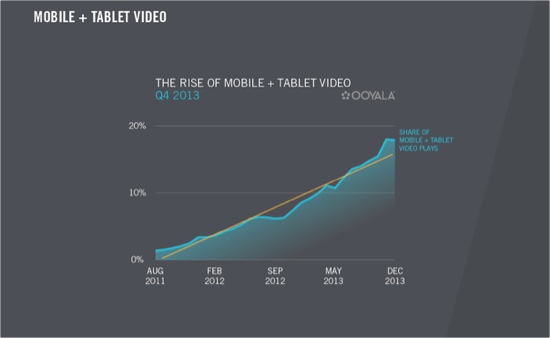
And in time for March Madness, the report indicates that mobile viewers are three times as likely to watch live sports on their mobile devices than video-on-demand content. Sports also dominates mobile viewing time, with longform sports content (10+ minutes in length) accounts for almost two-thirds of all mobile viewing time. Turner Sports concurs, indicating in a recent press release that mobile (smartphone and tablet) viewing of its NCAA men's basketball streams was up 71% in the tournament's first two weeks. Turner said the tournament had generated more than 64 million live video streams - 13.5 million hours - over that period, already eclipsing the 49 million lives streams for the entire 2013 tournament.
The Ooyala report is based on measuring the online viewing habits of more than 200 million Internet users in some 130 countries.
Sources - Half of All Video Views Could Be Via Mobile/Tablet By 2016, Sports Is Big Driver, Vidblog
Ooyala Gloval Video Index Q4 2013 report


Monday, March 31, 2014
Pew: Social News
Pew's State of News Media 2014 report includes a look at the growing role of social media in news consumption. Here's some highlights:


- News has a place in social media, but usage varies by site. Half of Facebook and Twitter users get news through their sites, as do 62% of Reddit users. With Facebook's high penetration, that means about 3 in 10 Americans get some news from Facebook. There's also some variation in use by site: Twitter is used to get breaking news, while Facebook is used more to share news with friends and followers. 78% of those getting news via Facebook see news items while using Facebook for other purposes.
- Audiences for news on social media differ by platform

- Social media carries, and is used by news consumers, for a wide range of topics. Almost half of Facebook news users report that they get news on 6 or more topics. Top news categories on Facebook include Entertainment News, Local community news, and sports. Local news topics account for at least 3 of the top 10 topics (I suspect a lot of the interest in, and use of, sports news is about local teams and events).


- Social news users not only get news via their social media, they're increasingly engaged with it: sharing or reposting news, discussing news, and posting their own photos, videos, and information about news events.
- News consumers who go directly to news sites for their news tend to be much heavier news users than those who get to news sites through Facebook or search engines. Those going directly to news sites go more often, consume more content, and spend more time than those arriving at news sites via referrals from social media and search engines.

- On Twitter, groups of people often come together in response to news events they care about. These groups tend to be those with strong opinions, which aren't likely to reflect broad public opinion. In addition, the rapid pace, short content limits, and lack of gatekeeping on Twitter means that initial opinions may be moderated as news consumers get more information
Sources - 8 Key Takeaways about Social Media and News, PewResearch Journalism Project report
State of the News Media 2014, full PewResearch Journalism Project study
Pew: Key Indicators of News Use
The PewResearch American Journalism Project released its State of the News Media report for 2013 last week. The report suggests a news industry in transition, and news audiences starting to shift their patterns of news use as they discover the value of newer news delivery options. Here's some highlights-
 The decline of print
The newspaper industry has been fighting, unsuccessfully, declining subscription and readership numbers for decades. Even with liberalized definitions for subscribers and the growth in usage of newspapers digital offerings, they managed only a 3% increase in total readership in the last NAA report.
The outlook's even worse for News Magazines' print editions. Newsstand sales have dropped 43% since 2008 (although subscriptions have remained steady). Two of the major US news magazines have abandoned print for online, and even with the significantly lower costs of online are struggling to survive.
Readership also continued to decline for the top alternative weeklies, although at a slower pace.
 Broadcast & Cable News
The broadcast networks tended to hang on to their aggregate news audiences, although differences continued to exist among the big three performances. On aggregate, audiences for both the evening and morning news shows grew slightly, but remained within the range of audience numbers over the last few years.
 Cable news network audiences declined slightly in 2013, but were coming off a Presidential election year (so no real surprise there). 2013 was more notable for the continuing fall of CNN, whose ratings have been hitting 20 year lows in recent weeks, leaving CNN in the cable news ratings basement. MSNBC, lacking a significant Republican to bash, dropped a quarter of its primetime audience in 2013. Fox News Channel retained its ratings dominance in ratings, and continue to reap the benefits, generating almost twice the revenues of CNN, and four times the revenues of MSNBC.
 Local newscasts from broadcast stations started to gain audiences in 2013, building on the growing morning news programming, and greater use of mid-day and afternoon time slots for expanded news offerings. With more stations doing news programming before the main evening newscast, and extending the time for those shows, employment opportunities in local news improved slightly - one of the few bright spots in traditional journalism.
Digital
The transformation of the news marketplace is being driven by digital. In 2013, 82% of Americans reported getting news on their desktops or laptops, and more than half (54%) reported getting news through their mobile devices. Online is where most people go first for news. Digital operations of newspapers saved readership numbers, and many (but not all) outlets found online subscriptions a growing source of revenues in an otherwise declining market. Digital advertising dollars remain the fastest growing segment (soon to surpass TV), although the share earned by traditional news outlets is shrinking and is unlikely to replace print and TV advertising losses. 2013, and the last few years, have seen a surge in the use of commercial online-only news outlets, other online news sources, and social media by audiences. outlets.
More transformational has been the developing role that social media plays in the news process. News users are increasingly involved in disseminating news (sharing reports), discussing it with others, and contributing content (primarily photos and videos) to developing stories.
Source: Key Indicators in Media & News, a report of the PewResearch Journalism Project (part of State of the News Media 2014 study)
 The decline of print
The newspaper industry has been fighting, unsuccessfully, declining subscription and readership numbers for decades. Even with liberalized definitions for subscribers and the growth in usage of newspapers digital offerings, they managed only a 3% increase in total readership in the last NAA report.
The outlook's even worse for News Magazines' print editions. Newsstand sales have dropped 43% since 2008 (although subscriptions have remained steady). Two of the major US news magazines have abandoned print for online, and even with the significantly lower costs of online are struggling to survive.
Readership also continued to decline for the top alternative weeklies, although at a slower pace.

The broadcast networks tended to hang on to their aggregate news audiences, although differences continued to exist among the big three performances. On aggregate, audiences for both the evening and morning news shows grew slightly, but remained within the range of audience numbers over the last few years.
 Cable news network audiences declined slightly in 2013, but were coming off a Presidential election year (so no real surprise there). 2013 was more notable for the continuing fall of CNN, whose ratings have been hitting 20 year lows in recent weeks, leaving CNN in the cable news ratings basement. MSNBC, lacking a significant Republican to bash, dropped a quarter of its primetime audience in 2013. Fox News Channel retained its ratings dominance in ratings, and continue to reap the benefits, generating almost twice the revenues of CNN, and four times the revenues of MSNBC.
Digital
Source: Key Indicators in Media & News, a report of the PewResearch Journalism Project (part of State of the News Media 2014 study)
Subscribe to:
Posts (Atom)